Smart Hotel Room Control & Access Platform
Embedded Access Control, Room Automation and Occupancy-Based Energy Management
A complete embedded hotel room control platform integrating access control, room status, lighting, HVAC and occupancy sensing into a locally autonomous system with centralized remote monitoring and administration.
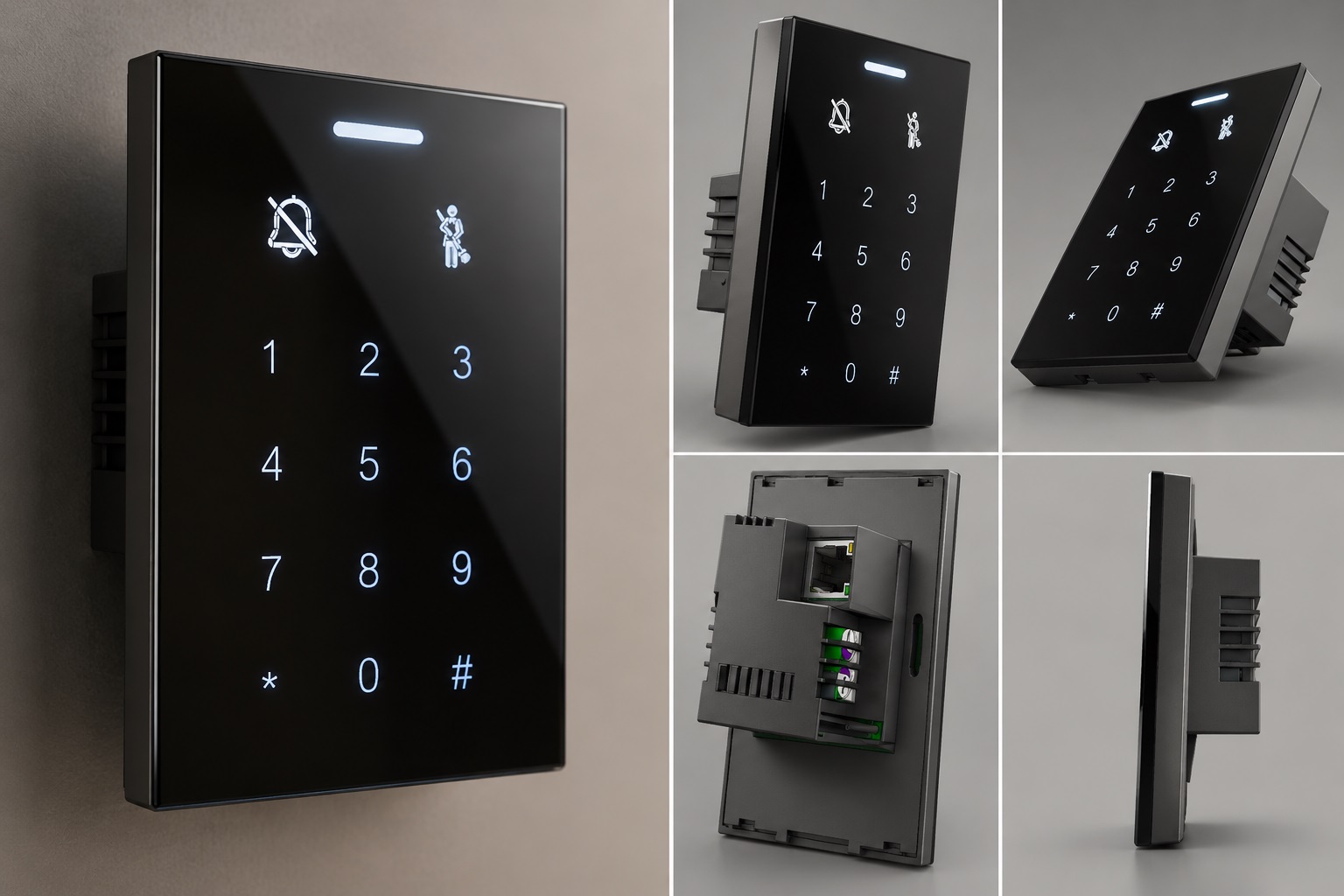
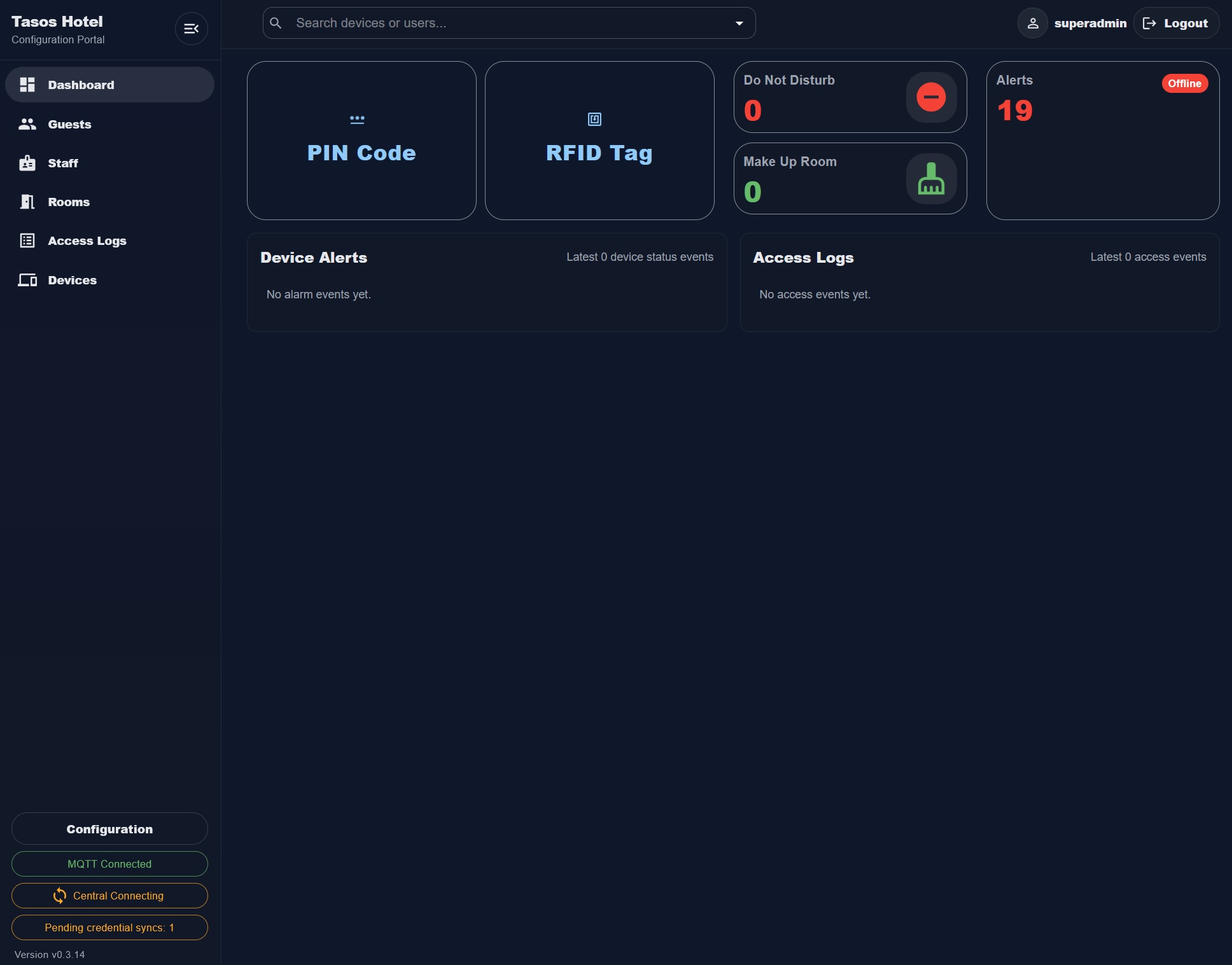
The system is designed as a complete hotel room technology platform — a connected room-control ecosystem combining access control, guest service status, lighting, HVAC, occupancy sensing, local hotel infrastructure and centralized remote monitoring.
The platform is being developed as a modular smart hotel room ecosystem. The Access Control Device is currently the completed and functional embedded product, while the DND / Make Up Room panel, lighting controller, touch thermostat and mmWave occupancy sensor are in the design and development phase.
- Local autonomy
- Hotel systems remain operational without Internet.
- Central supervision
- Central infrastructure provides monitoring and administration.
- Local source of truth
- Live device state is controlled by the hotel node.
- Secure remote control
- Remote commands are routed through the local backend.
- Scalability
- Architecture supports multiple hotels.
- Energy optimization
- Occupancy information enables intelligent HVAC and lighting control.
Five devices forming one coordinated room-control ecosystem, all connected to the local hotel node.
- · RFID / NFC credential reading
- · PIN keypad
- · Door strike / relay control
- · Local credential handling
- · Device identity & secure provisioning
- · Guest-controlled Do Not Disturb
- · Make Up Room request
- · Status synchronized with local hotel system
- · Lighting scenes
- · Local room lighting control
- · Occupancy-driven automated commands
- · Temperature setpoint
- · Fan control
- · Occupancy-based adjustment
- · Guest presence detection
- · Publishes occupancy to local node
- · Enables energy-saving automation
// Devices marked "In design": architecture defined, hardware design in progress. Not yet completed or deployed.
A hybrid local + central model. Each hotel runs its own operationally authoritative node; all room devices connect to it only. The central server is supervisory and administrative — not the live control endpoint for devices.
Operational data is stored locally first and synchronized to the central server in the background. If Internet connectivity is lost, local operation continues and synchronization resumes later.
Remote commands are routed through the local hotel node, never directly to devices.
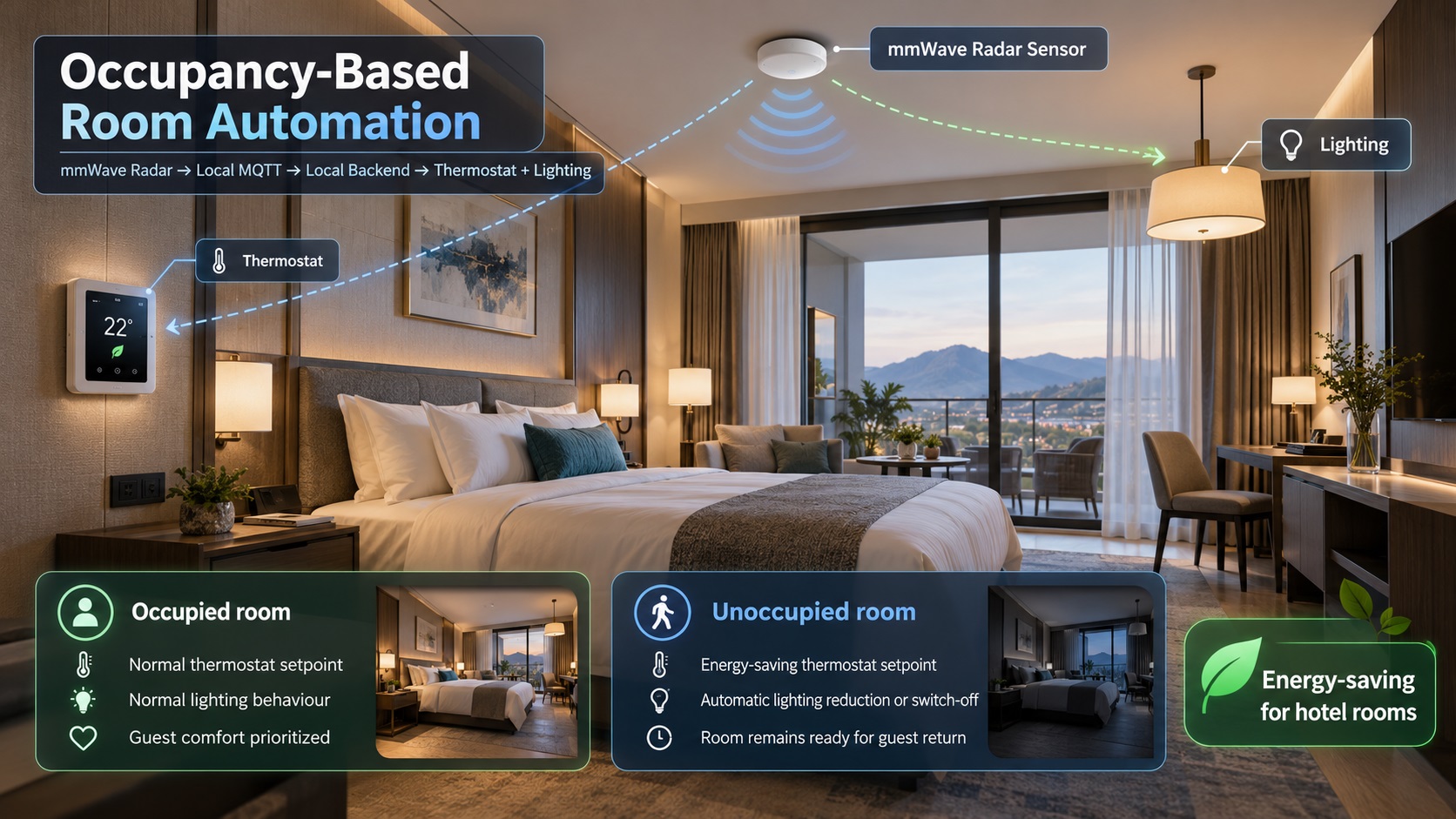
The mmWave radar detects guest presence and publishes occupancy state to the local MQTT broker. The local backend uses it to automate energy-related functions.
- ▸Normal thermostat setpoint
- ▸Normal lighting behaviour
- ▸Guest comfort prioritized
- ▸Energy-saving thermostat setpoint
- ▸Automatic lighting reduction or switch-off
- ▸Room remains ready for guest return
Local automation continues even when Internet connectivity is unavailable.
- ▸ESP32-WROOM-32E
- ▸PN7160 NFC controller
- ▸MPR121 capacitive touch controller
- ▸LAN8720 / LAN8710 Ethernet PHY
- ▸TPS2378 PoE interface
- ▸Relay / MOSFET door strike control
- ▸LED driver
- ▸Local power regulation
- ▸Ethernet primary, Wi-Fi fallback
- ▸Custom PCB design
- ▸Frontend web application
- ▸Backend API service (REST, MQTT integration)
- ▸MariaDB database
- ▸MQTT broker
- ▸Synchronization service & tracking
- ▸OTA firmware management
- ▸Command queue
- ▸User / device / credential management
- ▸Logging
- ▸Hotel / site identity
- ▸Central frontend web application
- ▸Central backend API
- ▸Central MariaDB database
- ▸Centralized monitoring & reporting
- ▸Audit history
- ▸Remote visibility & administration
- ▸OTA request orchestration
- ▸Aggregated multi-hotel data
- 01Designing reliable embedded devices suitable for continuous hotel operation
- 02Integrating capacitive touch, RFID/NFC, Ethernet, Wi-Fi and physical door-control hardware
- 03Designing a local-first architecture that remains operational during Internet outages
- 04Creating reliable communication between multiple room devices and the local hotel node
- 05Managing device identity and provisioning
- 06Implementing OTA firmware update capability
- 07Designing safe remote administration without making cloud infrastructure the primary runtime dependency
- 08Integrating mmWave occupancy sensing with HVAC and lighting control
- 09Balancing guest comfort and energy efficiency
- 10Designing the system so that it can scale from one hotel to multiple hotel sites
My role covered the complete technical development of the embedded platform, from hardware architecture and PCB design through firmware, networking, device communication, enclosure integration and system-level architecture.